

60-year-old male presented with paresthesias in bilateral upper and lower limbs with weak finger and toe movements for 6 months,associated with right arm pain.

Clinically, the patient was suspected to have chronic inflammatory demyelinating polyneuropathy (CIDP), but the patient was not improving with steroids
Nerve conduction study of upper and lower limbs revealed features of demyelinating neuropathy.
Ultrasonography of the nerves of right upper limb
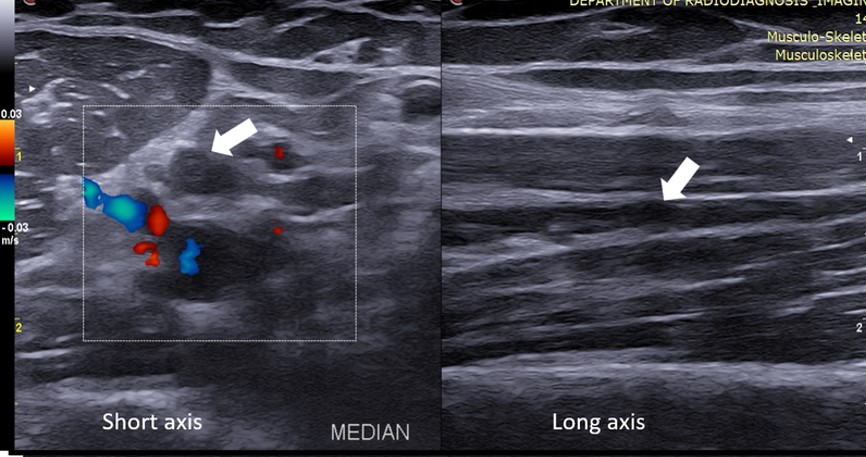
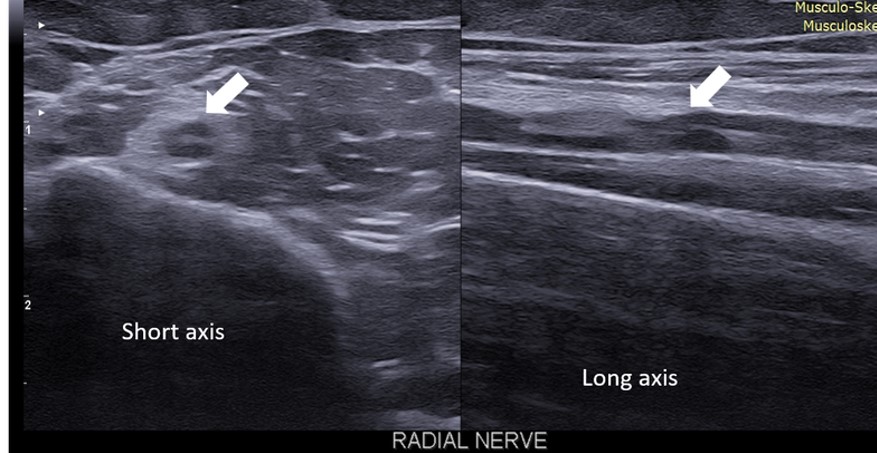
Thickening, hypoechogenicity and fascicular enlargement with increased perineural echogenicity of Median nerve (in arm) Image 1; and Radial nerve (in arm/spiral groove) – Image 2.
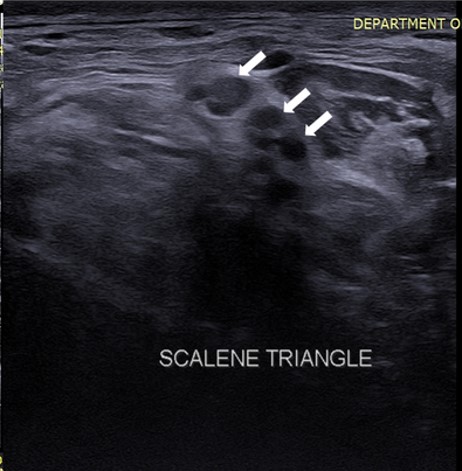
Similar thickening, hypo-echogenicity and fascicular enlargement of trunks of right brachial plexus in the scalene triangle
Radiograph of right shoulder and arm was done as a part of work up of arm pain
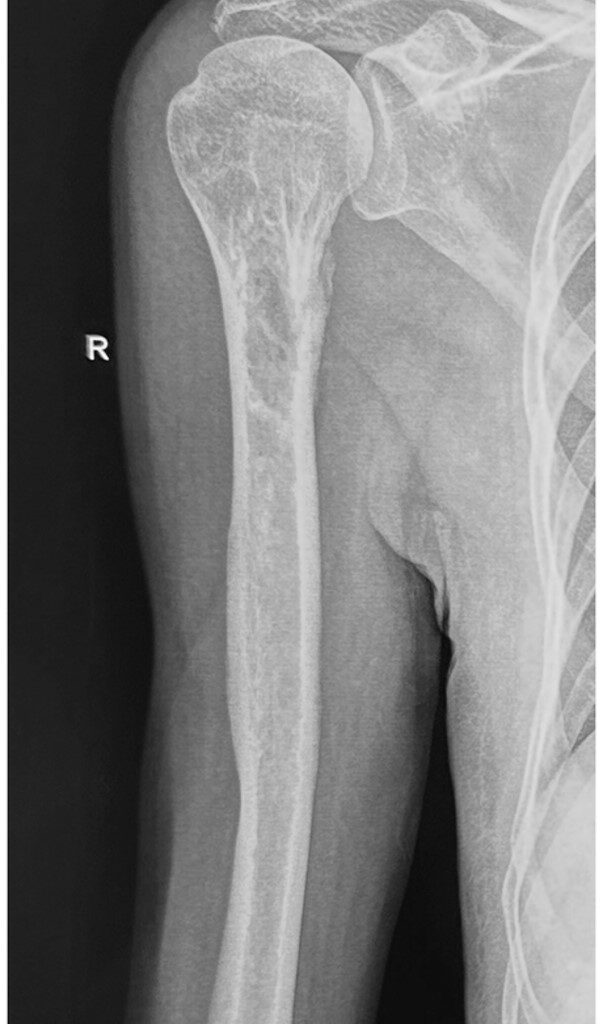
Aggressive or non-aggressive?
- Lytic lesion in right proximal diaphysis
- Sclerotic margin and narrow zone of transition inferiorly but wide zone of transition superiorly
- Focal cortical breach in the medial cortex with adjacent interrupted periosteal reaction.
- No appreciable matrix mineralization
LEARNING POINT:
Lesions on radiograph shoulder be classified according to their most aggressive radiographic characteristic.
Differential diagnosis
Aggressive bone lesions in a 60-year-old:
- Metastasis – most common malignant bone lesion after 40 years of age
- Multiple myeloma/plasmacytoma
- Lymphoma
- Primary bone neoplasm – chondrosarcoma
- Osteomyelitis (chronic)
Bone lesion + polyneuropathy
Could neuropathy be paraneoplastic?
NEXT STEP?
PET-CT was done for paraneoplastic workup, which revealed:
- Solitary bone lesion in right humerus – metabolically active
- Hepatosplenomegaly
- Cervical, axillary and inguinal lymphadenopathy
- No solid organ primary was identified.
MRI was performed to characterize the humeral lesion
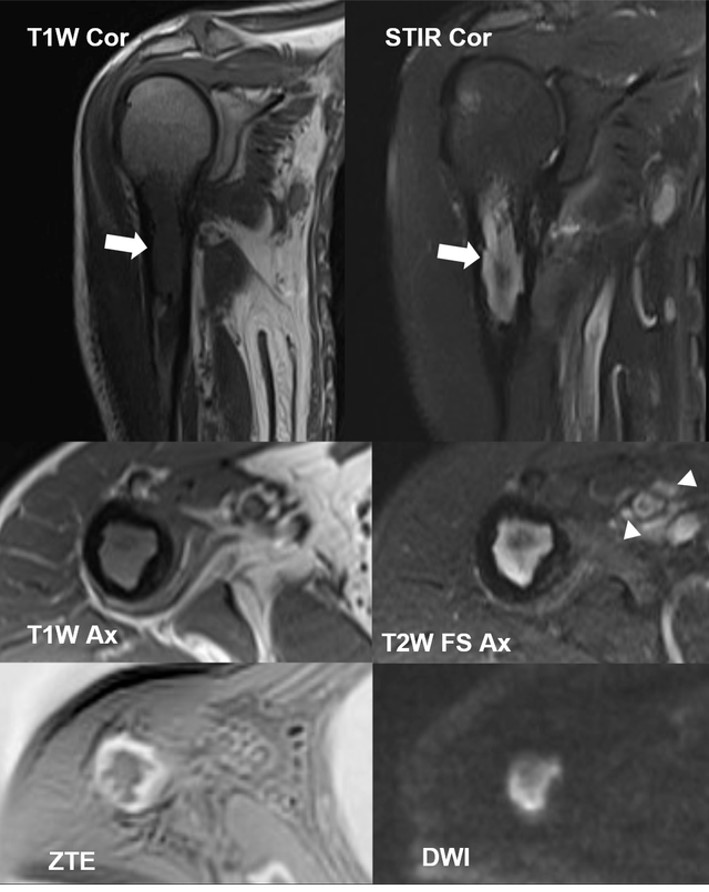
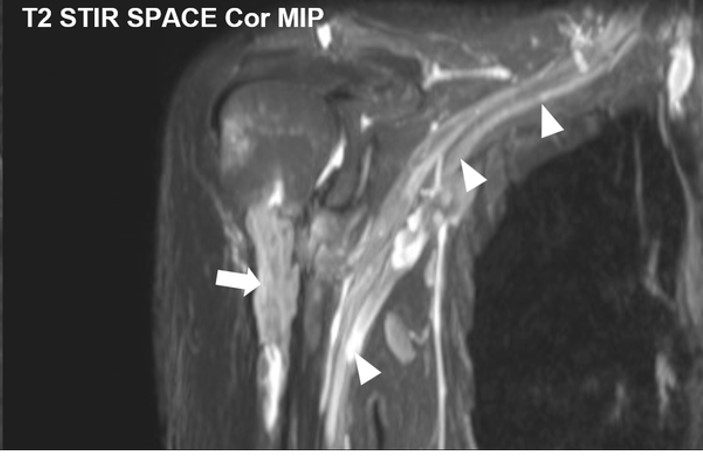
- T2 hyperintense and T1 intermediate heterogeneous lesion in proximal right humerus (metadiaphysis) with central T2 hypointense area
- Endosteal scalloping with thinning and focal breach of medial humeral cortex (best seen in ZTE image)
- Diffusion restriction seen peripherally
- No extra-osseous soft tissue component
- Thickening and T2 hyperintensity of the brachial plexus and nerves of the right upper limb (arrowheads) with prominent axillary lymph nodes (seen in T2 STIR SPACE (maximum intensity projection)
Differential diagnosis remains unchanged
A CT-guided biopsy was done from the right humeral lesion which revealed PLASMA CELL NEOPLASM WITH LAMBDA RESTRICTION
(CD45 – positive; CD138 – negative; Kappa – negative; Lambda – positive)
FINAL DIAGNOSIS
PLASMA CELL NEOPLASM WITH LAMBDA RESTRICTION AND PARANEOPLASTIC POLYNEUROPATHY
(? POEMS SYNDROME)
POEMS SYNDROME
- Rare paraneoplastic syndrome caused by an underlying monoclonal plasma cell neoplasm, usually with lambda light chain restriction.
- Elevated vascular endothelial growth factor (VEGF) is central to disease pathogenesis, resulting in increased vascular permeability, endoneurial edema, and multisystem involvement.
- Neuropathy is the predominant clinical feature and is often the presenting symptom.
| Category | Criteria |
|---|---|
| Mandatory major criteria | 1. Polyneuropathy (typically demyelinating) |
| 2. Monoclonal plasma cell-proliferative disorder (almost always λ) | |
| Other major criteria (one required) | 3. Castleman disease |
| 4. Sclerotic bone lesions | |
| 5. Vascular endothelial growth factor (VEGF) elevation | |
| Minor criteria | 6. Organomegaly (splenomegaly, hepatomegaly, or lymphadenopathy) |
| 7. Extravascular volume overload (edema, pleural effusion, or ascites) | |
| 8. Endocrinopathy (adrenal, thyroid, pituitary, gonadal, parathyroid, pancreatic) | |
| 9. Skin changes (hyperpigmentation, hypertrichosis, glomeruloid hemangiomata, plethora, acrocyanosis, flushing, white nails) | |
| 10. Papilledema | |
| 11. Thrombocytosis/polycythemia | |
| Other symptoms and signs | Clubbing, weight loss, hyperhidrosis, pulmonary hypertension/restrictive lung disease, thrombotic diatheses, diarrhea, low vitamin B12 values |
CIDP versus POEMS
POEMS syndrome frequently mimics chronic inflammatory demyelinating polyneuropathy (CIDP) because both present with progressive demyelinating sensorimotor neuropathy.
Features favoring POEMS include:
- Monoclonal gammopathy (usually IgA/IgG λ)
- Poor response to IVIG or corticosteroids
- Systemic manifestations
- Associated bone lesions
LEARNING POINTS
- Peripheral neuropathy may be the first manifestation of an occult malignancy, including plasma cell neoplasms.
- POEMS syndrome should be suspected in patients with progressive demyelinating neuropathy, monoclonal gammopathy, and an associated bone lesion.
- Imaging is invaluable in suspected paraneoplastic neuropathy for detecting the underlying malignancy, staging disease, guiding biopsy, and monitoring treatment.
- Radiologists should maintain a high index of suspicion for POEMS syndrome when a bone lesion is identified in a patient with unexplained or treatment-resistant CIDP-like neuropathy.
- Early clinicoradiological correlation enables prompt diagnosis and targeted therapy, improving neurological and oncological outcomes.